Scaling Liveheats into a global competition platform for sport communities
My role
Head of Design, part of the founding product–engineering–design trio shaping the core platform from side project to global SaaS business.
Scope
End-to-end product design across organiser, athlete, and spectator experiences, supporting the evolution of Liveheats from an early-stage product into a global competition platform used by sporting organisations worldwide.

Snapshot
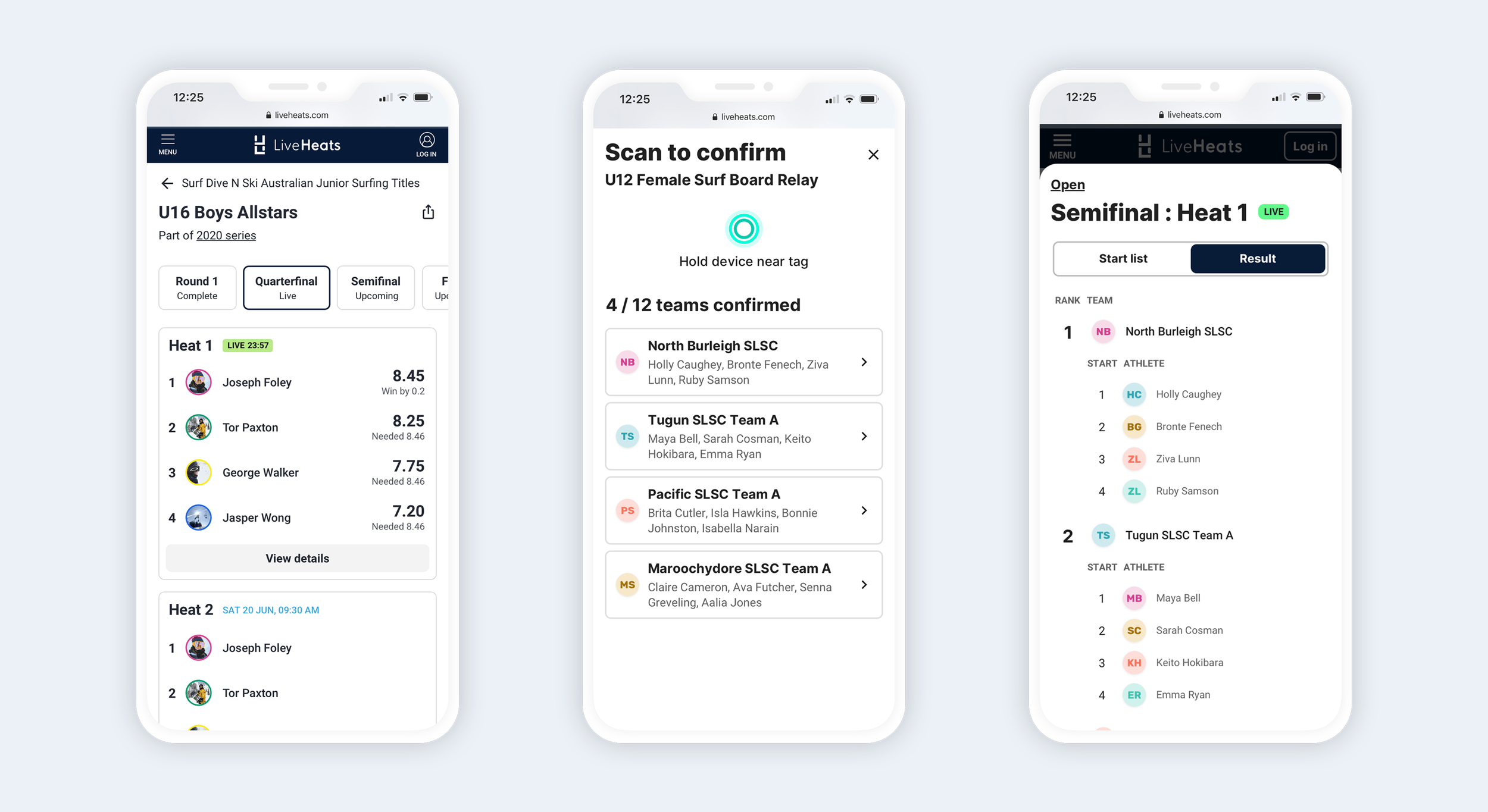
Liveheats is a real-time competition management platform powering surf, skate, snow, and ocean sports events globally. It replaces fragmented, manual competition workflows with a unified system for registrations, heat draws, live scoring, rankings, and publishing results across events.
The product enables organisers to run entire competitions end-to-end—from athlete registration to live judging and rankings—on a single connected platform.
My journey:
Core member of the founding product trio (product, engineering, design)
Led key UX transformation that enabled product adoption across global sport organisations
Improved core workflows for competition setup, live scoring, and results publishing
Contributed to regaining customers from competitors through improved usability and trust
Situation
Liveheats began as a side project helping sporting organisations manage competitions and live scoring.
Early traction was strong, but the product experience was not yet scalable:
Complex setup flows limited adoption beyond early users
Inconsistent UX across competition types created friction
Mobile and real-time experiences were not fully optimised
Some users moved to competitors with similar workflows
At this stage, the product was at a tipping point:
either evolve the UX into a scalable system or remain a niche tool.
Opportunity
The opportunity was to evolve Liveheats from a functional event tool into a trusted competition platform that could scale across sports, organisations and markets.
That meant designing for the pressure and complexity of live competition:
Support real-time scoring with zero tolerance for confusion or delay
Make live scoring usable in unpredictable, real-world event conditions
Allow organisers to build and manage complex heat structures quickly
Make judging feel fast, reliable and low-friction on mobile devices
Ensure results flow seamlessly into rankings and event publishing
Create flexible patterns that work across different sports, rules and formats
The challenge wasn’t simply making the product easier to use — it was creating a system sophisticated enough to run complex competitions, while feeling simple enough for anyone to pick up.
Approach
1. Mapping real-world competition workflows
A key early step was deeply understanding how competitions actually run:
How heats are structured (rounds, divisions, seeding)
How judges interact with athletes in real time
Where delays and errors typically occur (missed scores, timing mismatches)
How organisers mentally track progress during live events
This helped translate messy, real-world processes into structured product flows.
2. Designing for high-stakes real-time interaction
Live scoring environments are unforgiving—every interaction matters under time pressure.
Core design principles included:
Speed over decoration → every interaction optimised for rapid input
Clarity over flexibility → reduce ambiguity in scoring states
Single source of truth → eliminate mismatched versions of results
Immediate feedback loops → judges, announcers, and spectators see updates instantly
This directly supported Liveheats’ live scoring system where judges enter scores on phones/tablets and results propagate instantly across roles and audiences.
3. Building scalable systems for organisers
Beyond scoring, organisers needed control over entire competitions:
Event creation and configuration
Heat draw generation and scheduling
Athlete registration flows
Rankings logic and publishing
The design challenge was ensuring:
Complexity is available, but not overwhelming
Defaults handle 80% of use cases
Advanced configuration remains accessible without breaking simplicity
4. From standalone events → connected ecosystem
A major evolution was shifting Liveheats from “event tool” to a connected system:
Registrations feed directly into divisions
Heat draws automatically generate from entries
Results automatically update rankings
Events publish live updates for audiences
This required strong information architecture thinking—ensuring data flows cleanly across modules without manual intervention.
Solution
Evolved Liveheats into a more structured and usable platform by:
Redesigning core competition setup flows for simplicity and repeatability
Improving live scoring experience for real-world event environments
Standardising key interaction patterns across competitions and sports types
Strengthening mobile and responsive usability for organisers on the field
Creating a more coherent end-to-end experience from setup → live event → results
This helped transition Liveheats from an early MVP into a scalable SaaS platform.
Improved usability of core competition setup and live scoring workflows
Reduced friction for organisers managing real-time sporting events
Enabled platform scalability across multiple sports and organisation types
Helped transition Liveheats from early-stage product to global SaaS platform
Strengthened product consistency during a period of rapid growth and change
“The LiveHeats platform made an enormous difference at the Aussies this year. It’s an event that has more than 7,000 competitors and 600 officials which is a mammoth scale to coordinate the administrative side and results.”
SLSA’s National Sport Manager, Wayne Druery
What I learned
Designing for live environments is fundamentally different from standard product UX.
Systems thinking is critical when product modules are deeply interconnected (registration → scoring → rankings).
The best design work often comes from deeply understanding human behaviour under pressure.
Simplicity is not visual—it’s reducing cognitive load in high-stakes moments.
Early-stage product design is as much about shaping the system as shaping the UI.