Building the foundations for personalised government services
My role
Principal Product Designer across two squads; championed lean experimentation and data-led validation.
Scope
Improving customer profiles, personalisation, service discovery and data quality across millions of Service NSW customers.
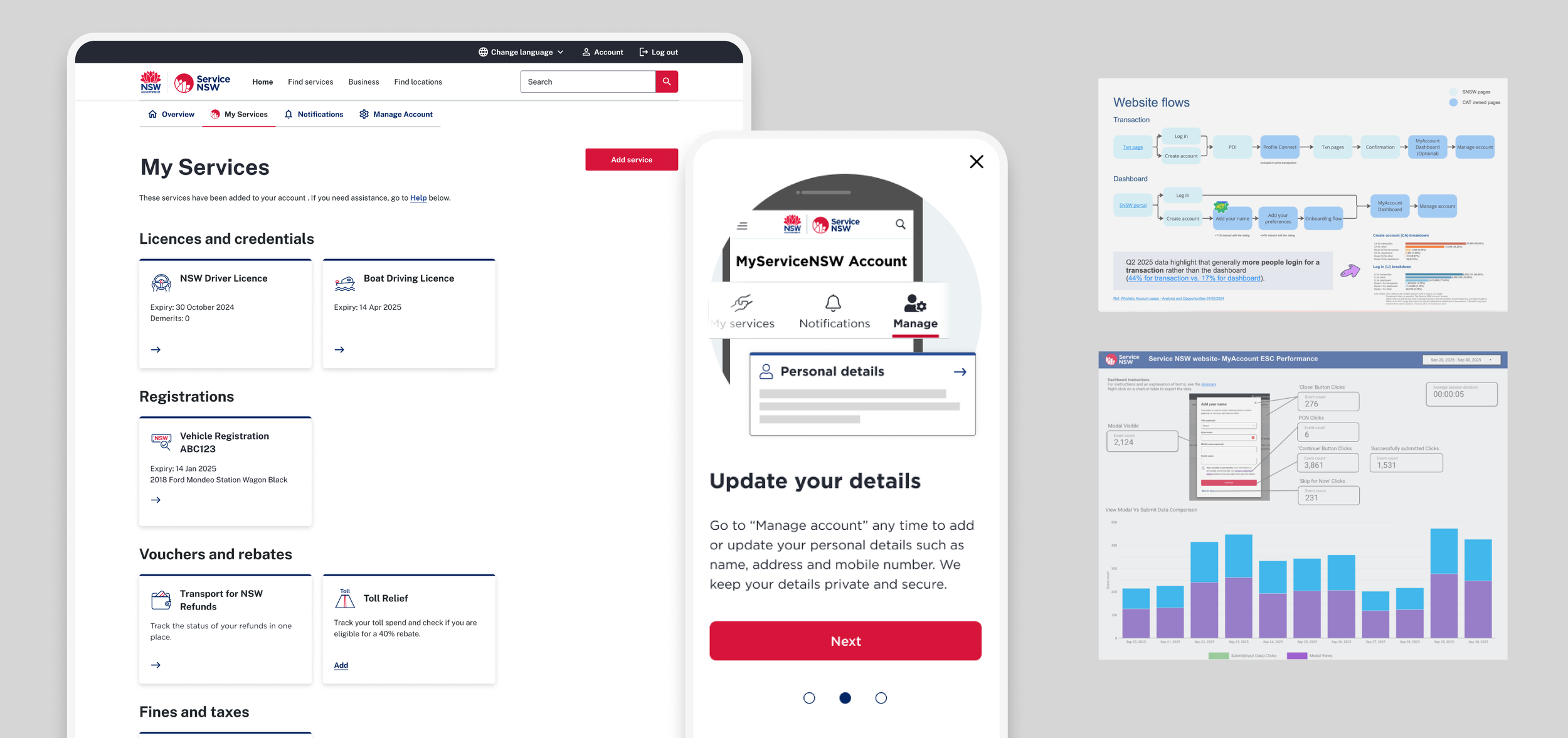
Snapshot
Led the design strategy for Service NSW Account and customer profile experiences
Introduced hypothesis-driven experimentation practices across the design team
Improved understanding of what customer data creates meaningful value
Explored AI-powered verification to improve customer data quality
Mentored and grew a multidisciplinary design team across two squads
Situation
The Service NSW Account is the foundation of many government services, yet customer information was often incomplete, outdated, or collected without a clear understanding of how it benefited customers.
This created several challenges:
Customers repeatedly entered the same information across services
Service discovery was largely generic rather than personalised
Application experiences contained unnecessary friction
Teams collected data without strong evidence that it improved outcomes
Maintaining accurate customer records remained a persistent challenge
As Service NSW continued expanding its digital services, improving customer data became critical to creating more relevant, efficient and personalised experiences.
Opportunity
The initial assumption was simple:
If we collect more customer information, we can personalise experiences.
However, our discovery revealed a more important question:
Which customer information actually creates value for customers?
Rather than collecting data for its own sake, we focused on understanding:
What information reduces effort during future applications?
What information improves service recommendations?
What information helps customers discover benefits they may not know exist?
What information can be maintained accurately over time?
This shifted the conversation from data collection to customer value.
Approach
I introduced a hypothesis-driven product development approach across both squads. Instead of building features based on assumptions, we focused on learning.
1. Establishing experimentation practices
I coached designers and product teams to frame work around measurable hypotheses:
We believe collecting X information will improve Y outcome because Z.
Each experiment defined:
Success metrics
Leading indicators
Customer value assumptions
Learning goals
Importantly, success wasn't measured by feature adoption alone.
A failed hypothesis was considered a valuable outcome if it improved our understanding of customer needs.
2. Customer data discovery
Alongside experimentation, I led discovery work to identify:
High-value customer attributes
Moments where customers were willing to share information
Trust considerations around data collection
Opportunities to reduce effort across future transactions
This helped prioritise the data that mattered most while avoiding unnecessary collection.
3. AI-powered verification
As an extension of the work, we explored how LLM-powered experiences could help customers maintain accurate address information.
The goal was to reduce manual effort, improve data quality, and increase confidence in customer records while maintaining trust and transparency.
Solution
The outcome wasn't a feature. It was a shift in strategy.
The experiment validated that:
Customers were willing to share personal information when value was clear
Trust was not the primary barrier
Reach and impact were more important considerations than completion rates alone
These insights helped shape future personalisation initiatives and informed where customer data collection efforts should be prioritised across the organisation.
I also initiated discussions with Privacy stakeholders to explore how customer information could be collected and reused responsibly without introducing unnecessary friction into the experience.
The work also established stronger experimentation practices across the team, improving how designers measured success, analysed outcomes, and used evidence to guide decisions.